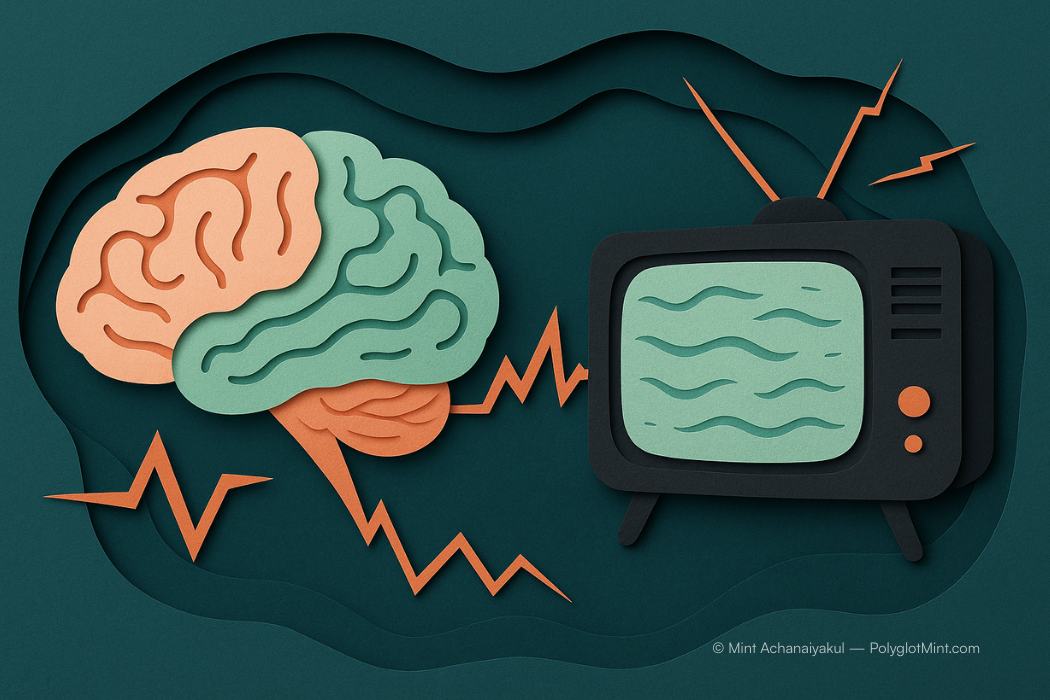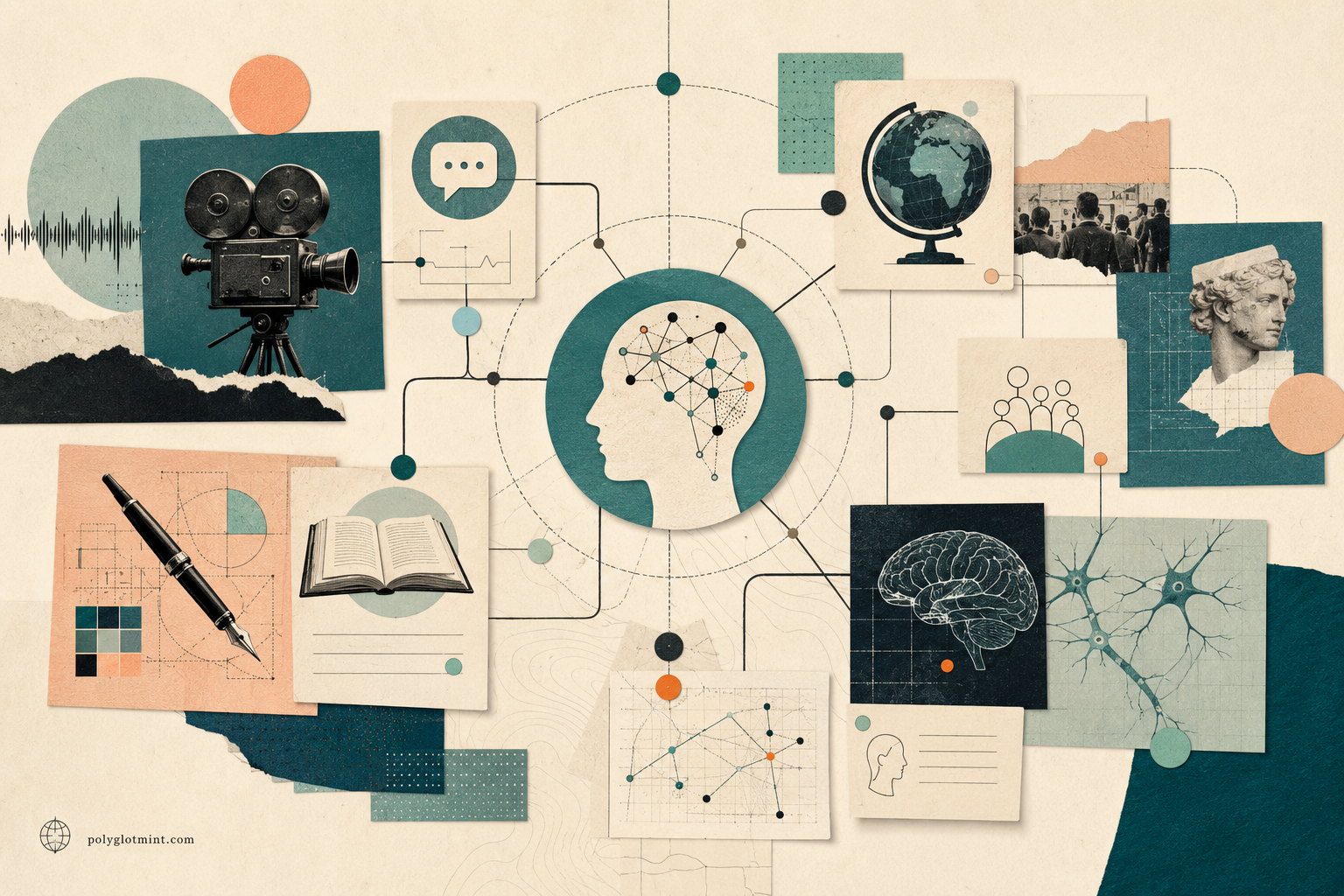
Image generated using AI under the creative direction and composition of Mint Achanaiyakul.
Abstract
If The Field of Psychomedia defines what Psychomedia is, The Discipline of Psychomedia explains how it can be studied.
Psychomedia is not only an idea about media and the mind. It is a structured framework for analyzing how language, symbol, image, sound, repetition, and design shape perception, emotion, identity, and nervous-system response over time.
The discipline brings together psychology, neuroscience, linguistics, media theory, design, and ethics into one research grammar. Its central question is simple:
What does a medium train the nervous system to feel, expect, believe, avoid, repeat, or become?
Psychomedia begins as philosophy, but it becomes discipline when its patterns can be observed, named, compared, tested, and used to design more coherent environments.
1. From Question to Method
The original question behind Psychomedia was:
Why does media feel like therapy and control at the same time?
That question became a method.
Psychomedia treats every medium as a psychological environment already in progress. A film, song, advertisement, social feed, game, headline, classroom, ritual, or room design does not only communicate meaning. It organizes attention. It changes arousal. It shapes emotional expectation. It teaches the body what to approach, fear, desire, imitate, or ignore.
According to Marshall McLuhan (1964) in Understanding Media: The Extensions of Man, media should be understood not only by their content, but by the environments and extensions they create. Psychomedia builds from this insight by asking how those environments affect the nervous system, especially when the viewer is already shaped by trauma, attachment, overstimulation, or social conditioning.
Each Psychomedia analysis begins with a triad:
stimulus → state → story
A stimulus enters the system. The body shifts state. The mind builds a story around that state.
When the story aligns with truth, coherence can increase. When the story conflicts with reality, dissonance grows. Over time, repeated dissonance can become identity, culture, or control.
2. The Structure of the Discipline of Psychomedia
The Discipline of Psychomedia has three interlocking research layers.
The Neural Layer
The neural layer studies how media affects arousal, attention, threat response, reward, memory, dissociation, and emotional regulation.
According to Bessel van der Kolk (2014) in The Body Keeps the Score, trauma reshapes the body and nervous system, not only conscious memory. Psychomedia applies this concern to media environments by asking how repeated symbolic exposure may activate, numb, rehearse, or regulate the same systems involved in trauma and survival.
This layer includes models such as the Duality of Neural Programming (DNP), which maps competing motivational circuits and their effects on perception, behavior, and emotional orientation.
The Linguistic Layer
The linguistic layer studies language as emotional code.
Words do not only transmit information. They carry inherited associations, emotional charge, social permission, and symbolic force. A repeated phrase can become a command. A label can become an identity. A metaphor can organize reality before the person knows they have accepted it.
According to Lakoff and Johnson (1980) in Metaphors We Live By, metaphor shapes perception and action, not merely language. Psychomedia extends this into media culture by asking how repeated linguistic frames install emotional expectations across individuals, groups, and generations.
This layer is articulated through Linguigenetic Theory (LEIT), which studies how language can function as inherited psychological programming.
The Coherence Layer
The coherence layer studies whether a symbolic environment supports integration or fragmentation.
A coherent environment helps perception, feeling, meaning, and action align. An incoherent environment produces dissonance: the body feels one thing, the image says another, the language disguises a third, and the person must adapt to the contradiction.
Psychomedia uses coherence as both an analytic and ethical principle. The question is not only whether media is beautiful, persuasive, popular, or entertaining. The question is whether it helps the nervous system remain connected to truth.
3. Empirical Foundations
Psychomedia does not need to invent new measurement tools from nothing. It draws from existing methods across neuroscience, psychology, linguistics, media research, and design analysis.
Possible methods include:
- autonomic markers such as heart rate, breath, and stress physiology
- attention and arousal measures
- EEG, event-related potentials, or neuroimaging where appropriate
- discourse analysis and framing analysis
- semantic drift mapping
- motif and symbol tracking across media environments
- audience response studies
- qualitative trauma-informed interviews
- design analysis of attention, salience, pacing, sound, color, and repetition
According to Albert Bandura (2001) in Social Cognitive Theory of Mass Communication, media can shape behavior through observational learning, modeling, and social reinforcement. Psychomedia builds from this by studying not only what behavior is modeled, but what emotional states are rehearsed, rewarded, normalized, or made desirable.
Where a relationship is not yet established, Psychomedia treats it as a hypothesis rather than a conclusion.
This distinction matters.
The discipline does not claim every image causes harm, every story programs the mind, or every viewer responds the same way. It asks what patterns appear repeatedly, what responses they tend to produce, and under what conditions those responses become meaningful.
4. Taxonomies and Working Models
Psychomedia organizes observation through taxonomies and working models.
A taxonomy names the pattern. A model explains the mechanism.
One example is the Dissonance Taxonomy, which categorizes conflicts that may destabilize coherence: linguistic, visual, spatial, moral, emotional, sonic, symbolic, informational, or relational. These categories help identify the specific mismatch the nervous system is being asked to resolve.
For example:
- A cheerful song may carry violent imagery.
- A loving phrase may conceal control.
- A beautiful image may normalize humiliation.
- A calming aesthetic may hide moral distortion.
- A repeated joke may train contempt.
Psychomedia does not stop at saying “this is problematic.” It asks how the pattern works.
What is repeated? What state does it create? What association does it install? What behavior does it reward? What form of awareness does it suppress?
This is how media analysis becomes mechanism analysis.
5. Integration Across Disciplines
Psychomedia bridges disciplines that are often studied separately.
Psychology studies the mind. Neuroscience studies the brain and body. Linguistics studies language. Media studies studies representation. Design studies studies form and experience. Ethics studies responsibility.
Psychomedia asks what happens when all of these are part of the same event.
A piece of media is never only content. It is also language, rhythm, color, pacing, sound, social script, emotional rehearsal, and symbolic environment. The viewer is never only an audience member. They are a nervous system receiving patterned input.
This is why Psychomedia treats ethical design as more than taste.
Design can regulate or dysregulate. Language can clarify or distort. Images can integrate or fragment. Stories can return agency or train obedience.
The discipline is therefore both diagnostic and generative. It can reveal how conditioning is installed, and it can guide the design of environments that restore clarity, agency, and emotional stability.
6. The Mission of the Discipline
The purpose of Psychomedia is not censorship. It is awareness.
Psychomedia does not argue that media should become flat, moralistic, safe, or sterile. It argues that creators, researchers, educators, and audiences need better language for understanding what media does to the nervous system over time.
Its mission is to train perception. To distinguish stimulation from meaning. To distinguish control from truth. To distinguish compulsion from coherence. To distinguish attention capture from genuine aliveness.
The long-term aim is a culture capable of creating media that does not depend on humiliation, fragmentation, addiction, fear, or overstimulation to hold attention.
This is the idea behind neurologically sustainable entertainment: art and communication that can move the nervous system without exploiting it.
Conclusion
The Discipline of Psychomedia turns a field into a method.
It asks how symbolic environments shape the nervous system, how repeated patterns become emotional training, and how media can either fracture or restore coherence.
If The Field of Psychomedia names the territory, The Discipline of Psychomedia gives that territory a research grammar.
It begins with a simple claim:
Media is not only something people watch. It is something the nervous system learns from.
And if the nervous system is learning, then the question is no longer only what media means.
The question is what media trains us to become.
Achanaiyakul, M. (2026). The Discipline of Psychomedia. PolyglotMint.com.
References
Bandura, A. (2001). Social Cognitive Theory of Mass Communication. Media Psychology.
Lakoff, G., & Johnson, M. (1980). Metaphors We Live By. University of Chicago Press.
McLuhan, M. (1964). Understanding Media: The Extensions of Man. McGraw-Hill.
Van der Kolk, B. A. (2014). The Body Keeps the Score: Brain, Mind, and Body in the Healing of Trauma. Viking.