Psychomedia: The Psychology of Media, Trauma, and Control
If trauma reorganizes the nervous system, what happens when media rehearses traumatic patterns—and teaches the language of reality?
Published Field-Definition Paper
Version 1.0 · Mint Achanaiyakul · DOI: 10.5281/zenodo.21393492
Abstract
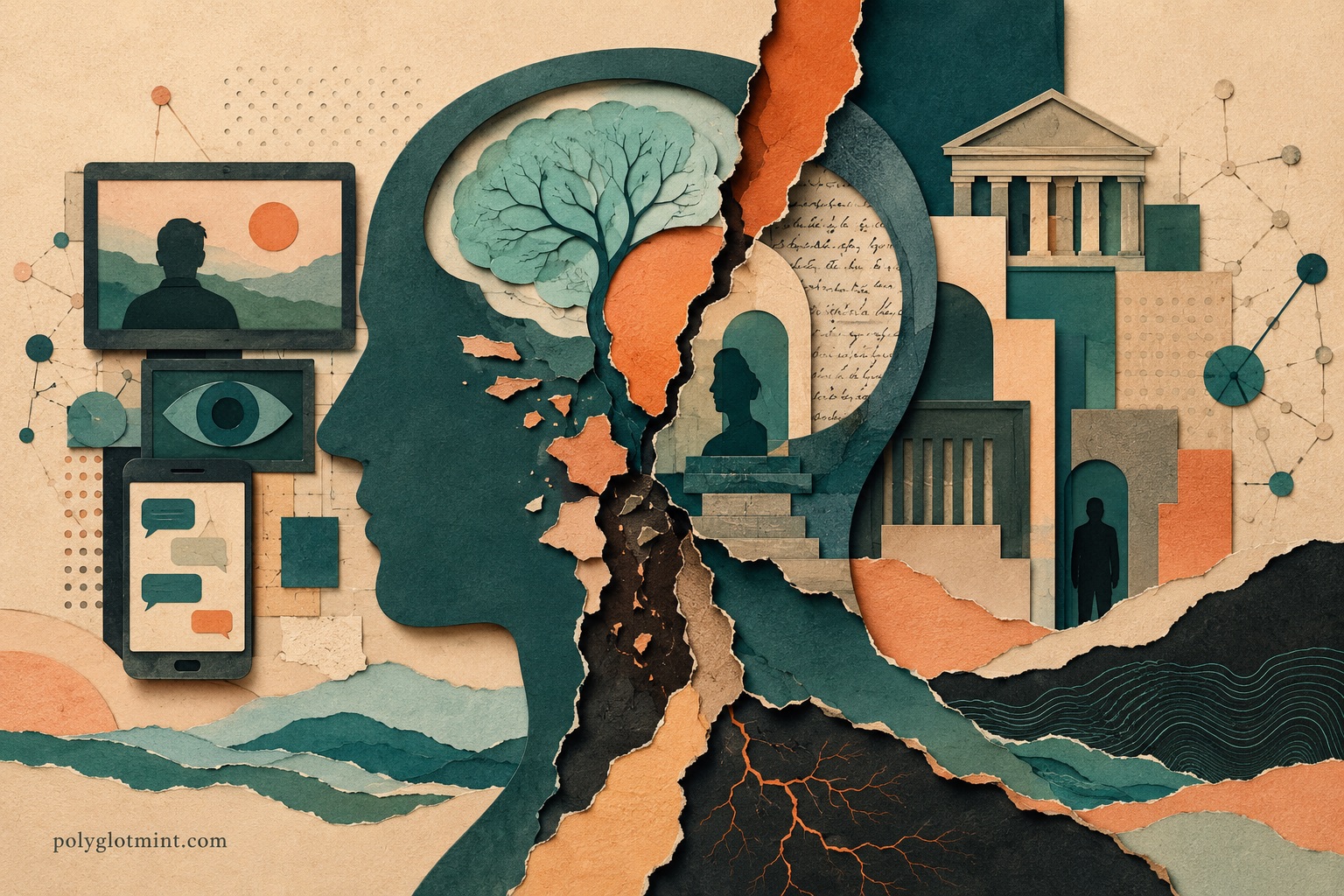
Psychomedia is a developing interdisciplinary field that studies how media, trauma, and control interact to shape perception, emotion, memory, identity, language, and collective awareness. It begins from the observation that the nervous system does not develop only through families, schools, communities, and direct relationships. It also develops through repeated contact with images, stories, platforms, algorithms, advertisements, celebrities, news cycles, linguistic frames, and digital rituals.
Rather than treating media as neutral entertainment and trauma as an exclusively private or clinical problem, Psychomedia examines their shared terrain: the learned grammar through which the nervous system interprets what is real, safe, desirable, shameful, powerful, threatening, or inevitable. It investigates how repeated symbols, narrative structures, emotional tones, reward systems, and linguistic patterns may rehearse distress, normalize coercion, shape attachment, direct attention, and construct inner worlds that feel self-generated even when they have been culturally installed.
Psychomedia integrates insights from psychology, neuroscience, trauma studies, media studies, communication research, linguistics, semiotics, cultural analysis, and systems theory. Its central proposition is that media should be studied not only as content but as an environment in which perception and emotional expectation are repeatedly trained.
This paper defines the field, introduces its core concepts, distinguishes it from adjacent disciplines, outlines possible methods and applications, and identifies directions for future research.
Status and Scope
This web article presents an adapted overview of Psychomedia as an interdisciplinary conceptual framework and developing field of inquiry. It does not report original empirical findings, establish direct clinical causation, or replace clinical diagnosis, treatment, neuroscience, media studies, or established trauma research.
Why Psychomedia Is Necessary
Traditional psychology studies the mind, emotion, behavior, trauma, and attachment. Media studies examines representation, narrative, ideology, and cultural meaning. Communication research analyzes persuasion, audience effects, advertising, and agenda-setting. Linguistics and semiotics study how language and symbols carry meaning. Neuroscience studies plasticity, memory, reward, arousal, attention, and dissociation.
Each field explains part of the problem. None fully answers the modern question at the center of Psychomedia:
What happens when the nervous system develops inside an always-on media environment that behaves like a relationship, a language teacher, and a trauma rehearsal system at the same time?
For people living with trauma, media may function as both trigger and anesthesia. People fall asleep to shows to avoid silence. They scroll to avoid feeling. They rely on fictional characters, parasocial figures, and serialized content for emotional continuity. At the same time, some media systems reproduce patterns recognizable from abusive relational systems: intermittent reward, humiliation, shock, manufactured shame, idealization, degradation, and emotional whiplash.
According to Bessel van der Kolk (2014) in The Body Keeps the Score, trauma is not only remembered as an event; it reorganizes the body, brain, and capacity for safety. According to Marshall McLuhan (1964) in Understanding Media: The Extensions of Man, media are not passive containers for content; they reshape perception by extending and reorganizing human experience. Psychomedia begins where these insights meet: media environments do not merely represent trauma. They can rehearse, amplify, aestheticize, normalize, and transmit trauma-patterns through symbolic repetition.
This is why a new field is necessary. The modern mind is not shaped only by personal biography. It is shaped by repeated contact with media systems that train emotional expectation, moral intuition, self-image, language, attention, and desire.
What Psychomedia Studies
Psychomedia studies how media environments shape the nervous system and the inner world over time.
Its focus is not only on individual shows, songs, posts, films, celebrities, or trends. It studies patterns: repetition, escalation, symbolic cueing, linguistic framing, reward loops, humiliation scripts, aestheticized pain, and emotional conditioning.
Psychomedia asks:
- How do repeated images and stories rehearse fear, shame, numbness, humiliation, euphoria, moral disgust, or learned helplessness?
- How do media narratives normalize relational patterns such as gaslighting, coercion, conditional love, humiliation-as-bonding, or abuse framed as empowerment?
- How do language, symbols, costumes, lighting, lyrics, and recurring tropes become emotional cues in the collective subconscious?
- How does media saturation affect people who are already traumatized, overloaded, lonely, dissociated, or developmentally vulnerable?
Psychomedia is concerned with both acute media experiences and cumulative exposure. It includes the study of repeated minor shocks, contradictions, humiliations, fear cues, and destabilizing signals that may gradually alter what feels normal, tolerable, desirable, or inevitable.
According to George Gerbner (1998) in Cultivation Analysis: An Overview, long-term exposure to media can shape a viewer's perception of reality. Psychomedia extends this concern into the body and nervous system. It asks not only what media teaches people to believe, but what media teaches them to feel, expect, tolerate, repeat, and become.
Subconscious
The layer of mental life beneath conscious awareness, where associations, emotional patterns, and learned responses are stored and quietly shape perception and behavior.
Cognitive World-Building
A central concept in Psychomedia is cognitive world-building.
Cognitive world-building describes the process by which repeated words, images, sounds, tropes, and storylines construct inner worlds. Once built, these worlds can be activated by a single cue: a phrase, color, costume, song, camera angle, celebrity archetype, or symbolic image.
A person may experience a response as spontaneous even when the emotional association has been reinforced through repeated exposure. A word can arrive preloaded with shame. A type of body can arrive preloaded with contempt or desire. A costume can arrive preloaded with innocence, danger, holiness, submission, glamour, or ridicule. A story structure can teach the body which forms of pain are romantic, which forms of power are attractive, and which forms of humiliation are funny.
This is where media and control meet.
If an inner world can be built, it can also be triggered. If it can be triggered, pressure can be built. If pressure can be built, it can be released and redirected. Psychomedia studies this chain:
construct the world activate the cue generate the state direct the response
How Psychomedia Differs from Existing Fields
Psychomedia is not simply media criticism. It is not only psychology applied to films or social media. It is not a replacement for clinical diagnosis, trauma therapy, neuroscience, media studies, or communication research.
It is an integrative field focused on the interface between media systems and the nervous system.
Existing fields offer important foundations:
- Psychology explains trauma, attachment, personality, emotion, and mental health.
- Media studies explains symbolism, representation, ideology, and narrative.
- Communication research explains persuasion, audience effects, advertising, and agenda-setting.
- Neuroscience explains reward, arousal, memory, learning, plasticity, and dissociation.
- Linguistics and semiotics explain framing, metaphor, language, and symbolic meaning.
Psychomedia connects these domains by treating media as a relational and symbolic environment. It asks how media behaves like a teacher, attachment figure, abuser, anesthetic, ritual, mirror, and operating system for perception.
According to Albert Bandura (2001) in Social Cognitive Theory of Mass Communication, media can shape behavior through observational learning and modeled consequences. Psychomedia expands this into trauma and culture: if people repeatedly observe humiliation, domination, dissociation, addiction, revenge, or self-erasure being rewarded or aestheticized, those patterns may become part of the emotional vocabulary through which they interpret reality.
In this sense, Psychomedia does not only ask, "What does this content mean?"
It asks, "What does this pattern do to a nervous system after five, ten, or twenty years of repetition?"
Dissociation
A disruption or alteration in awareness, memory, identity, perception, or connection to one’s thoughts, feelings, body, or surroundings. Trauma-related dissociation requires careful clinical assessment.
Media as Trauma Ecology
Psychomedia treats modern media as a trauma ecology: an environment where images, sounds, stories, and language patterns can either support coherence or intensify fragmentation.
This does not mean all media is harmful. Media can comfort, educate, inspire, connect, and repair. Stories can metabolize grief. Art can restore meaning. Humor can reduce fear. Beauty can return sensation to the body.
The problem begins when media systems reward dysregulation at scale.
A platform optimized for attention may repeatedly stimulate threat, outrage, envy, desire, shame, and compulsive checking. A franchise may teach viewers to bond with violence, humiliation, or emotional unavailability. A celebrity system may turn breakdown into spectacle. A news cycle may rehearse helplessness until the body learns that reality itself is unmanageable.
According to Ruth Lanius (2015) in Trauma-related dissociation and altered states of consciousness, trauma-related dissociation involves altered states of consciousness that require deeper clinical and neuroscientific attention. Psychomedia asks how media environments may interact with dissociation: not by causing every altered state, but by giving traumatized or overloaded systems endless symbolic material through which numbness, fragmentation, and escape can be rehearsed.
Methods and Approach
Psychomedia combines several modes of analysis:
- trauma-informed observation of how media affects numbness, panic, dissociation, identification, attachment, and compulsive return;
- neuroscience-informed analysis of arousal, reward, attention, overload, and nervous-system regulation;
- motif and pattern analysis across film, television, music videos, advertising, social media, news, and influencer culture;
- linguistic and semiotic mapping of emotional cueing, humiliation scripts, gaslighting structures, inversion logic, and symbolic conditioning;
- ecological analysis of information overload, emotional-frequency environments, and the loss of tolerance for silence, boredom, grief, or unmediated presence;
- design-oriented research into media and offline environments that support coherence, empathy, honesty, and real connection.
The central methodological question remains consistent:
What happens to the nervous system, inner narrative, and collective subconscious in repeated contact with this pattern of media and language?
Symbolic conditioning
The training of automatic emotional or behavioral responses through repeated symbols, images, and language — until a cue arrives already “preloaded” with a feeling.
Applications of Psychomedia
Psychomedia opens several applied frontiers.
For individuals, it offers a way to recognize when a media diet is not merely entertaining them, but keeping them numb, hypervigilant, fragmented, ashamed, or emotionally absent from their own lives.
For clinicians, it offers language for discussing media as an active force in identity formation, dissociation, attachment, and emotional regulation. A client may not only be reacting to family history. They may also be living inside an ongoing symbolic environment that repeats the emotional pattern of that history.
For educators, Psychomedia expands media literacy into nervous-system literacy. Students do not only need to ask whether a message is true or false. They need to ask what it trains the body to expect, desire, fear, ridicule, obey, or ignore.
For creators, it offers ethical design questions. Does this story glamorize coercion? Does this image eroticize collapse? Does this joke train contempt? Does this platform reward fragmentation? Does this environment help people become more coherent, or more addicted to stimulation?
According to Stephen Porges (2011) in The Polyvagal Theory, the nervous system's regulation of safety, attachment, communication, and self-regulation is central to human social experience. Psychomedia applies this concern culturally: media environments also teach the body when to feel safe, when to brace, when to numb, and when to attach.
Long-Term Vision
Psychomedia is a field, a research agenda, and a cultural lens.
Its long-term goal is to give people language for forces that have shaped them invisibly. It aims to support trauma-informed media literacy, clinical discussion, cultural analysis, ethical creation, and the design of media and physical environments that restore coherence rather than intensify fragmentation.
The field also requires a lexicon. Terms such as cognitive world-building, media-induced numbness, emotional-frequency environments, symbolic conditioning, and collective subconscious scripting help name patterns that many people feel but cannot yet explain.
Ultimately, Psychomedia seeks a culture that is not engineered around whatever captures attention at any cost, but around what helps human beings remain coherent, empathic, truthful, and free.
Notes on Novelty
Psychomedia introduces a unified framework in which trauma neuroscience, media theory, linguistics, symbolism, and cultural control are treated as one system rather than parallel disciplines.
Its novelty lies in treating media as an active participant in the nervous system's trauma ecology. Media does not merely reflect culture. It can install emotional templates, rehearse relational patterns, reshape moral intuition, and alter the symbolic environment through which people interpret themselves and others.
Psychomedia also reframes media analysis as preventive mental health work and cultural diagnostics. It does not ask only whether media is good or bad. It asks what patterns media repeats, what states those patterns train, and what forms of selfhood become easier or harder to access after years of repetition.
The novelty claimed here concerns this specific integrated framework, field definition, vocabulary, and scale of analysis. It is not a claim that no earlier writer or institution has used the word psychomedia in another context or that its individual foundational mechanisms have never been studied separately.
Conclusion
Psychomedia is the psychology of media, trauma, and control.
It studies how media environments shape perception, emotion, memory, identity, language, and collective awareness. It asks how repeated symbols become inner worlds, how inner worlds become triggers, and how those triggers can be used to build pressure, release it, and redirect attention.
The field begins from a simple premise: the mind is not formed in isolation. It is formed in environments.
In the modern world, media is one of those environments.
To study media without the nervous system is incomplete. To study trauma without culture is incomplete. To study control without language and symbolism is incomplete.
Psychomedia exists to name the hidden architecture between them.
Recommended Citation
Achanaiyakul, M. (2025). Psychomedia: The psychology of media, trauma, and control (Version 1.0). PolyglotMint. https://doi.org/10.5281/zenodo.21393492
Selected References
Bandura, A. (2001). Social Cognitive Theory of Mass Communication. Media Psychology.
Gerbner, G. (1998). Cultivation Analysis: An Overview. Mass Communication & Society.
Lanius, R. A. (2015). Trauma-related dissociation and altered states of consciousness: A call for clinical, treatment, and neuroscience research. European Journal of Psychotraumatology.
McLuhan, M. (1964). Understanding Media: The Extensions of Man. McGraw-Hill.
Porges, S. W. (2011). The Polyvagal Theory: Neurophysiological Foundations of Emotions, Attachment, Communication, and Self-Regulation. W. W. Norton.
van der Kolk, B. A. (2014). The Body Keeps the Score: Brain, Mind, and Body in the Healing of Trauma. Viking.
For the complete reference list, methods, limitations, research questions, and extended field definition, view the published paper on Zenodo.
This work is licensed under the Creative Commons Attribution 4.0 International License (CC BY 4.0).
First published by PolyglotMint on October 17, 2025. Revised July 16, 2026.