DNP and the Bipolar Spectrum
Oscillation, coherence, and compulsion
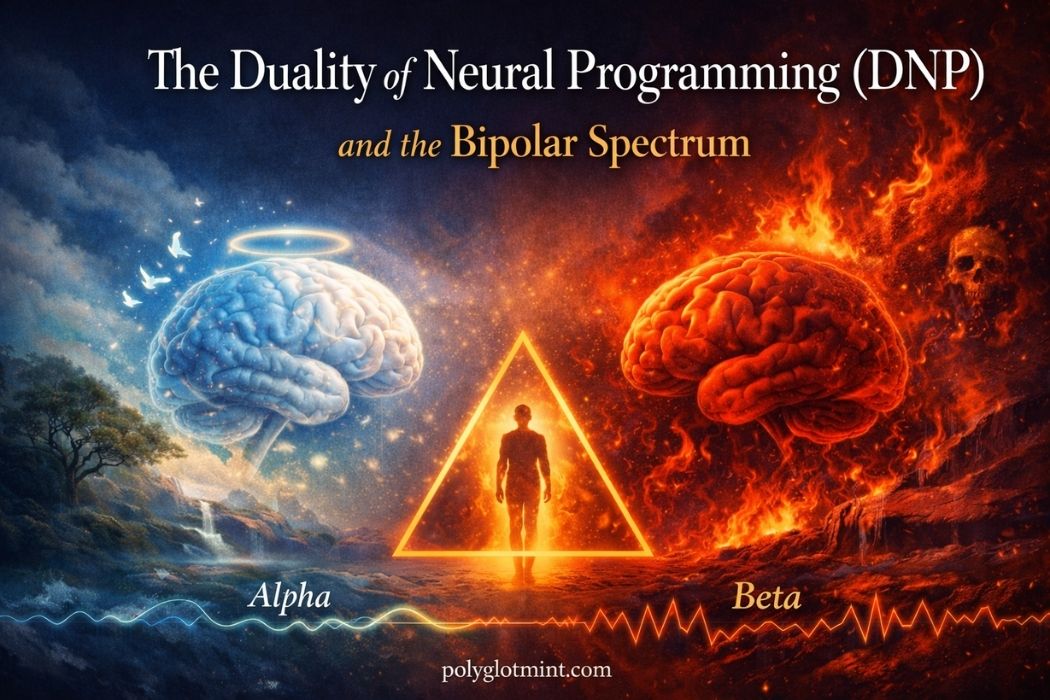
Image generated using AI under the creative direction and composition of Mint Achanaiyakul.
Abstract
This paper applies the Duality of Neural Programming (DNP) framework to the bipolar spectrum.
DNP proposes that human consciousness moves between two broad nervous-system state families: the Love–Life Circuit, associated with coherence, connection, regulation, integration, and sustainable reward; and the Sex–Death Circuit, associated with compulsion, threat, craving, fragmentation, domination, urgency, and destructive repetition.
In this paper, the bipolar spectrum is not reduced to these circuits. Bipolar disorder is a clinical and biological condition that requires careful medical, psychiatric, and psychological understanding. Instead, DNP offers a theoretical lens for studying the felt structure of oscillation: the movement between arousal and collapse, coherence and compulsion, integration and fragmentation.
The model draws from psychoanalytic drive theory, affective neuroscience, EEG research, trauma theory, and media-conditioning analysis. It argues that bipolar-spectrum states may be understood not only as chemical or mood events, but also as rhythm-governance events: shifts in how the nervous system regulates energy, meaning, reward, inhibition, and selfhood over time.
Clinical and Theoretical Boundary
This paper is not a diagnostic guide, treatment model, or medical explanation of bipolar disorder. It does not replace psychiatric care, medication, therapy, crisis support, or clinical evaluation.
DNP is a Psychomedia framework. Its purpose is to propose a language for studying state oscillation, symbolic input, trauma conditioning, and nervous-system governance. When it speaks about mania, depression, mixed states, or bipolar-spectrum patterns, it does so as theory and interpretation, not as medical instruction.
The paper also includes symbolic and spiritual language. Those layers should be understood as interpretive, not as claims that bipolar disorder is spiritually caused or morally defined.
Why DNP Belongs Near the Bipolar Spectrum
The bipolar spectrum is often described through mood: mania, hypomania, depression, and mixed states. But mood alone does not capture the full lived experience of oscillation.
Bipolar-spectrum states can also involve changes in energy, perception, salience, speed, desire, confidence, threat, spiritual meaning, bodily charge, social interpretation, and agency. The world can appear not merely happier or sadder, but more charged, more meaningful, more urgent, more hostile, more connected, more empty, or more impossible to regulate.
DNP enters here. It asks not only what mood is present, but what state family has become dominant.
Is the system moving toward coherence or capture? Is energy serving integration or compulsion? Is meaning becoming clearer or more inflated? Is arousal expanding agency or narrowing it? Is the person becoming more connected to reality, or more governed by urgency?
This is why the bipolar spectrum is important for DNP. It makes state oscillation visible.
Freud's Dual Drives Revisited
Freud's Beyond the Pleasure Principle introduced a tension between life-oriented drives and destructive repetition. Later language often summarized this through Eros and Thanatos: life and death, binding and unbinding, creation and destruction.
DNP does not simply repeat Freud's model. It reorganizes the contrast. In DNP, the central opposition is not sex versus death, or pleasure versus destruction. The central opposition is coherence versus compulsion.
The Love–Life Circuit names states in which energy remains integrated: desire can bond, attention can stabilize, and meaning can remain connected to truth.
The Sex–Death Circuit names states in which energy becomes fused with threat, craving, domination, urgency, and self-destruction. It is not sexuality itself. It is sexuality, intensity, or reward caught inside destructive repetition.
The bipolar spectrum becomes relevant because it often involves extreme shifts in energy governance. Energy can rise without integration. Meaning can intensify without grounding. Desire can surge without stable agency. Collapse can follow overextension. This does not mean mania “is” the Sex–Death Circuit. It means some manic, hypomanic, mixed, or dysregulated states can be interpreted through that circuit when arousal becomes fused with compulsion.
The Love–Life Circuit as Coherence
The Love–Life Circuit describes a state family organized around coherence.
In this state family, energy does not disappear. It becomes more governable. Attention can stabilize. Feeling can remain tolerable. Desire can exist without possession. Meaning can deepen without becoming inflated. The person can remain connected to others, to reality, and to the body.
In relation to bipolar-spectrum experience, the Love–Life Circuit is not simply the absence of symptoms. It is not flatness, sedation, or forced calm. It is a state in which energy can move without tearing the system apart.
A person in Love–Life coherence may still feel grief, intensity, creativity, longing, anger, conviction, or spiritual meaning. The difference is that these states remain integrated. They do not require the person to abandon sleep, reality-testing, agency, relational responsibility, or self-protection.
According to Klimesch (2012) in Alpha-band oscillations, attention, and controlled access to stored information, alpha-band dynamics are associated with controlled access and inhibitory governance. DNP does not claim that alpha activity equals coherence in a simple or moral sense. It uses alpha research as one anchor for thinking about regulated access: the ability of the nervous system to modulate what enters awareness, what is suppressed, and what becomes behavior.
Coherence is not the absence of charge. Coherence is charge that can be held.
The Sex–Death Circuit as Compulsion
The Sex–Death Circuit describes a state family organized around compulsion.
In this state family, the nervous system is pulled toward urgency, craving, domination, threat-salience, destructive repetition, or collapse. Energy becomes difficult to govern. Meaning becomes too charged. Desire begins to feel like command. Fear begins to feel like revelation. Repetition begins to feel like fate.
In bipolar-spectrum terms, this circuit may resemble certain manic, hypomanic, mixed, or agitated states when arousal exceeds integration. The person may feel intensely alive, chosen, accelerated, desired, powerful, or spiritually electrified. But if the state narrows agency, disrupts sleep, increases risk, fragments reality-testing, or converts intensity into compulsion, the system may no longer be moving toward life. It may be moving toward capture.
According to Ashok, Marques, and Howes (2017) in The dopamine hypothesis of bipolar affective disorder, dopaminergic models of bipolar disorder emphasize dysregulation and switching dynamics rather than a single static imbalance. This supports the idea that bipolar-spectrum states should be studied as dynamic systems of reward, drive, salience, and regulation.
According to Murri et al. (2016) in The HPA Axis in Bipolar Disorder: Systematic Review and Meta-Analysis, stress-axis alterations are supported in bipolar disorder research. This matters for DNP because the Sex–Death Circuit is not only about pleasure or desire. It is also about stress, threat, depletion, and overactivation.
Compulsion begins where energy stops serving agency.
Oscillation as Rhythm Governance
DNP does not treat bipolar-spectrum oscillation as a simple swing between “good” and “bad” states. The more precise question is governance.
Can the system regulate energy? Can arousal remain connected to reality? Can meaning intensify without becoming delusional or destructive? Can desire remain linked to care, truth, and consequence? Can collapse be understood without becoming identity?
Bipolar-spectrum oscillation may involve shifts in the governance of rhythm: sleep-wake rhythm, reward rhythm, attention rhythm, social rhythm, threat rhythm, and meaning rhythm.
According to Nunes et al. (2022) in A critical evaluation of dynamical systems models of bipolar disorder, dynamical-systems approaches offer a way to model mood instability and switching without reducing the condition to a single cause. DNP aligns with this direction by treating bipolar-spectrum experience as pattern, rhythm, and state transition, rather than as isolated symptoms.
This does not make DNP a medical model. It makes DNP a symbolic-state model that can sit beside clinical research.
The key claim is careful: bipolar-spectrum states may be studied as oscillations in nervous-system governance, where coherence, compulsion, arousal, inhibition, and collapse interact over time.
Alpha, Beta, and the Problem of Over-Simplification
The original DNP model used alpha and beta rhythms as part of its state mapping. This can be useful, but it must be handled carefully.
Alpha cannot simply be equated with “good.” Beta cannot simply be equated with “bad.” No EEG band should be turned into moral symbolism. The stronger claim is functional.
Alpha-band dynamics are often discussed in relation to inhibition, access control, and selective suppression. Beta dynamics are increasingly discussed in relation to active control, maintenance, and burst-like deployment. These rhythms may help describe how the nervous system governs attention and state.
According to Foxe and Snyder (2011) in The alpha-band rhythm: A sensory suppression mechanism during selective attention, alpha can help shape what enters awareness through selective suppression. According to Lundqvist (2024) in Beta: bursts of cognition, beta is increasingly understood through burst-based cognitive control rather than as a smooth continuous mode.
For DNP, this suggests a research direction: coherence may require controlled access, while compulsion may involve control surges that fail to integrate. This is not a completed empirical claim. It is a hypothesis.
Mania, Depression, and Mixed States Through DNP
DNP should not say, “mania equals the Sex–Death Circuit” or “depression equals suppressed Love–Life.” That is too crude. A better framing is this:
Some manic or hypomanic states may resemble Sex–Death capture when energy becomes fused with urgency, grandiosity, craving, domination, risk, or spiritual inflation.
Some depressive states may involve collapse after failed governance, depleted reward, suppressed coherence, or the exhaustion of prolonged overactivation.
Some mixed states may feel like the collision of both: high charge without integration, collapse with agitation, despair with urgency, spiritual intensity with fear, or desire with self-destruction.
In DNP, the bipolar spectrum is therefore not reduced to two circuits. It is treated as a field where circuits, rhythms, trauma histories, symbolic environments, sleep, stress, biology, and relationships interact.
This is why the model must stay humble. It can offer language. It cannot replace diagnosis. It can identify patterns. It cannot claim universal cause.
Spirituality and Bipolar-Spectrum Experience
Spirituality is one of the most delicate areas in bipolar-spectrum discussion.
Some spiritual experiences are stabilizing, integrative, grounding, relational, and ethically clarifying. Others may become grandiose, terrifying, compulsive, isolating, or destabilizing, especially during mania, mixed states, psychosis, or sleep deprivation.
DNP offers a non-shaming question: does this experience increase integration or disorganization?
A spiritually meaningful state does not have to be pathologized. But intensity alone does not prove truth. Revelation without integration can become dangerous. Symbolic charge without grounding can become destabilizing. The question is not whether the experience feels powerful. The question is whether it moves the person toward coherence, care, humility, truthfulness, embodied safety, and relational responsibility.
According to Lucchetti et al. (2021) in Spirituality, religiosity and mental health: A review, spirituality and religiosity can be associated with better mental-health outcomes in many contexts, but effects depend on context, coping style, and vulnerability. According to Jackson et al. (2022) in Religiosity and spirituality in bipolar disorder: A scoping review, spirituality and religiosity are clinically meaningful for many people with bipolar disorder and should be approached carefully rather than ignored.
DNP adds a rhythm-and-governance lens: Is the spiritual state integrated? Is it embodied? Is it reality-connected? Does it preserve agency? Does it deepen love, responsibility, and truth? Or does it accelerate compulsion, grandiosity, isolation, and collapse?
This distinction matters because spiritual language can either support coherence or intensify fragmentation.
Media Conditioning and Bipolar-Spectrum Vulnerability
Psychomedia asks how symbolic environments train the nervous system.
For bipolar-spectrum vulnerability, this question becomes especially important. Media environments can amplify speed, urgency, comparison, conflict, sexualized salience, threat, humiliation, spiritual grandiosity, and compulsive reward. For many people, this is simply overstimulating. For more sensitive nervous systems, it may become destabilizing.
DNP does not claim that media causes bipolar disorder. It claims that media can interact with state vulnerability.
Algorithmic feeds reward intensity. Narratives rehearse threat and craving. Images train desire and comparison. Language can amplify shame or grandiosity. Sleep can be displaced by stimulation. Attention can become fragmented before the person notices.
In DNP language, media can function as circuit training. It can rehearse Love–Life coherence or Sex–Death capture. It can strengthen regulation or intensify compulsion. It can help a person return to reality, or keep them suspended in charged symbolic loops.
This is where DNP becomes practical for Psychomedia. The question is not only “What does this media mean?” The question is “What state does this media repeatedly train?”
Population-Scale Claims and Responsible Limits
The original DNP framework includes a population-scale concern: that media ecosystems may shape collective affective baselines. This is an important idea, but it needs careful boundaries.
DNP should not claim that societies literally become clinically manic or depressed in the same way individuals do. Collective affect is not the same as individual diagnosis. A group cannot be diagnosed with bipolar disorder.
The more responsible claim is that media environments can amplify collective arousal, threat, craving, collapse, and emotional contagion. They may produce patterns that resemble mood-state dynamics at scale, without being identical to clinical bipolarity.
This distinction protects the model from overreach. A person has a nervous system. A society has networks, symbols, institutions, incentives, and feedback loops. The patterns can resemble each other, but they are not the same object.
DNP can study the resonance between individual oscillation and collective affect without collapsing one into the other.
Symbols as Circuit Inputs
Symbols are not passive.
A symbol can organize attention before a person explains it. A word can create bodily response before conscious interpretation. A recurring image can become a state cue. A mythic contrast — light and dark, ascent and fall, purity and corruption, heaven and hell — can shape how the nervous system organizes meaning.
According to Do and Hasselmo (2021) in Neural Circuits and Symbolic Processing, symbolic processing involves circuits that connect representation with learning and action selection. According to Silvert et al. (2004) in Autonomic responding to aversive words without conscious awareness, aversive words can evoke autonomic response even without full conscious awareness.
DNP interprets this through Psychomedia: language is not merely content. Symbol is not merely decoration. Meaning is not only mental. Symbolic environments can become state environments.
This is why DNP connects to Linguigenetic Theory (LEIT) and broader Psychomedia work. Repeated symbolic input may train the nervous system toward coherence or capture, depending on how it is structured, repeated, rewarded, and embodied.
Research Frontier
DNP opens a research frontier rather than closing one. Possible questions include:
- How do different symbolic environments affect arousal, attention, perceived agency, and emotional regulation?
- Do certain media patterns increase state instability in people already vulnerable to mood oscillation?
- How do sleep disruption, algorithmic stimulation, and reward cues interact with bipolar-spectrum risk?
- Can language framing shift bodily state, moral salience, or perceived compulsion?
- How can creators design media that supports coherence without becoming flat, sterile, or avoidant?
- What safeguards are necessary so affective-state research is not used for manipulation?
The ethical boundary is essential. A field that studies media conditioning must not become a tool for better conditioning. Psychomedia must remain oriented toward awareness, agency, and protection against manipulation.
Integration with the Main DNP Framework
This paper is a companion to The Duality of Neural Programming (DNP).
The main DNP paper defines the two state families: Love–Life and Sex–Death. This paper applies the model to bipolar-spectrum oscillation and asks how coherence, compulsion, arousal, collapse, spirituality, and media conditioning may interact in state-sensitive nervous systems.
It also connects to other Psychomedia frameworks.
Denial Architecture Disorder (DAD) explains how avoidance can harden into structure. Bipolar oscillation may reveal instability in state governance, while DAD explains how defensive systems become built environments inside the psyche.
Panic vs Blankness clarifies the difference between high-arousal expression and inhibited shutdown. This matters for DNP because not all distress looks like activation. Sometimes collapse, blankness, and numbness are also part of state oscillation.
Linguigenetic Theory (LEIT) explains how language may install inherited patterns of meaning. DNP extends this by asking how language changes state dominance.
symbol trains state; state trains perception; perception trains desire; desire trains behavior; behavior becomes pattern; pattern becomes identity.
Notes on Novelty
Bipolar disorder has already been studied through mood instability, reward dysregulation, sleep disruption, stress-axis alteration, oscillatory abnormalities, circuit-level dysregulation, and dynamical-systems models.
DNP does not claim to replace this work. Its contribution is synthetic and interpretive. It proposes that bipolar-spectrum experience can also be examined as a problem of state governance: how energy, meaning, reward, inhibition, spiritual charge, symbolic input, and agency interact inside a nervous system that oscillates.
Its novelty lies in linking:
- Love–Life and Sex–Death as state families
- coherence and compulsion as governance patterns
- symbolic input as nervous-system instruction
- media conditioning as state training
- spirituality as either integrative or destabilizing depending on governance
- bipolar-spectrum oscillation as a field where these patterns become visible
This is not a final answer. It is a research grammar.
Conclusion
DNP and the Bipolar Spectrum proposes that bipolar-spectrum oscillation can be studied through the relationship between coherence, compulsion, arousal, collapse, and symbolic conditioning.
The Love–Life Circuit names states where energy serves integration. The Sex–Death Circuit names states where energy becomes captured by urgency, craving, threat, domination, or fragmentation.
Bipolar-spectrum experience cannot be reduced to either circuit. But it can reveal how dramatically the nervous system can move between state worlds.
The question is not only whether a person is elevated or depressed. The deeper question is: what is governing the state?
If energy rises, does it serve coherence or compulsion? If meaning intensifies, does it deepen truth or inflate unreality? If the system collapses, is it resting, protecting, or shutting down? If media enters the loop, does it regulate or hijack?
DNP does not claim to solve bipolar disorder. It offers a language for studying the architecture of oscillation.
Because what the nervous system repeats, it begins to recognize. And what it recognizes long enough, it may begin to mistake for the self.
Achanaiyakul, M. (2026). DNP and the Bipolar Spectrum. PolyglotMint.com.
References
Ashok, A. H., Marques, T. R., & Howes, O. D. (2017). The dopamine hypothesis of bipolar affective disorder. Neuroscience & Biobehavioral Reviews.
Do, J. P., & Hasselmo, M. E. (2021). Neural Circuits and Symbolic Processing. Frontiers in Systems Neuroscience.
Foxe, J. J., & Snyder, A. C. (2011). The alpha-band rhythm: A sensory suppression mechanism during selective attention. Frontiers in Psychology.
Jackson, C., Hayward, M., & Cook, C. C. H. (2022). Religiosity and spirituality in bipolar disorder: A scoping review. International Journal of Bipolar Disorders.
Klimesch, W. (2012). Alpha-band oscillations, attention, and controlled access to stored information. Trends in Cognitive Sciences.
Lucchetti, G., Koenig, H. G., & Lucchetti, A. L. G. (2021). Spirituality, religiosity and mental health: A review. Revista Brasileira de Psiquiatria.
Lundqvist, M. (2024). Beta: bursts of cognition. Trends in Cognitive Sciences.
Murri, M. B., Prestia, D., Mondelli, V., et al. (2016). The HPA Axis in Bipolar Disorder: Systematic Review and Meta-Analysis. Psychoneuroendocrinology.
Nunes, A., et al. (2022). A critical evaluation of dynamical systems models of bipolar disorder. Translational Psychiatry.
Silvert, L., Delplanque, S., Bouwalerh, H., Verpoort, C., & Sequeira, H. (2004). Autonomic responding to aversive words without conscious awareness. International Journal of Psychophysiology.
