Panic vs Blankness: Two Trauma Responses We Misread
Panic means the trauma is loud. Blankness means the trauma feels too dangerous to access.
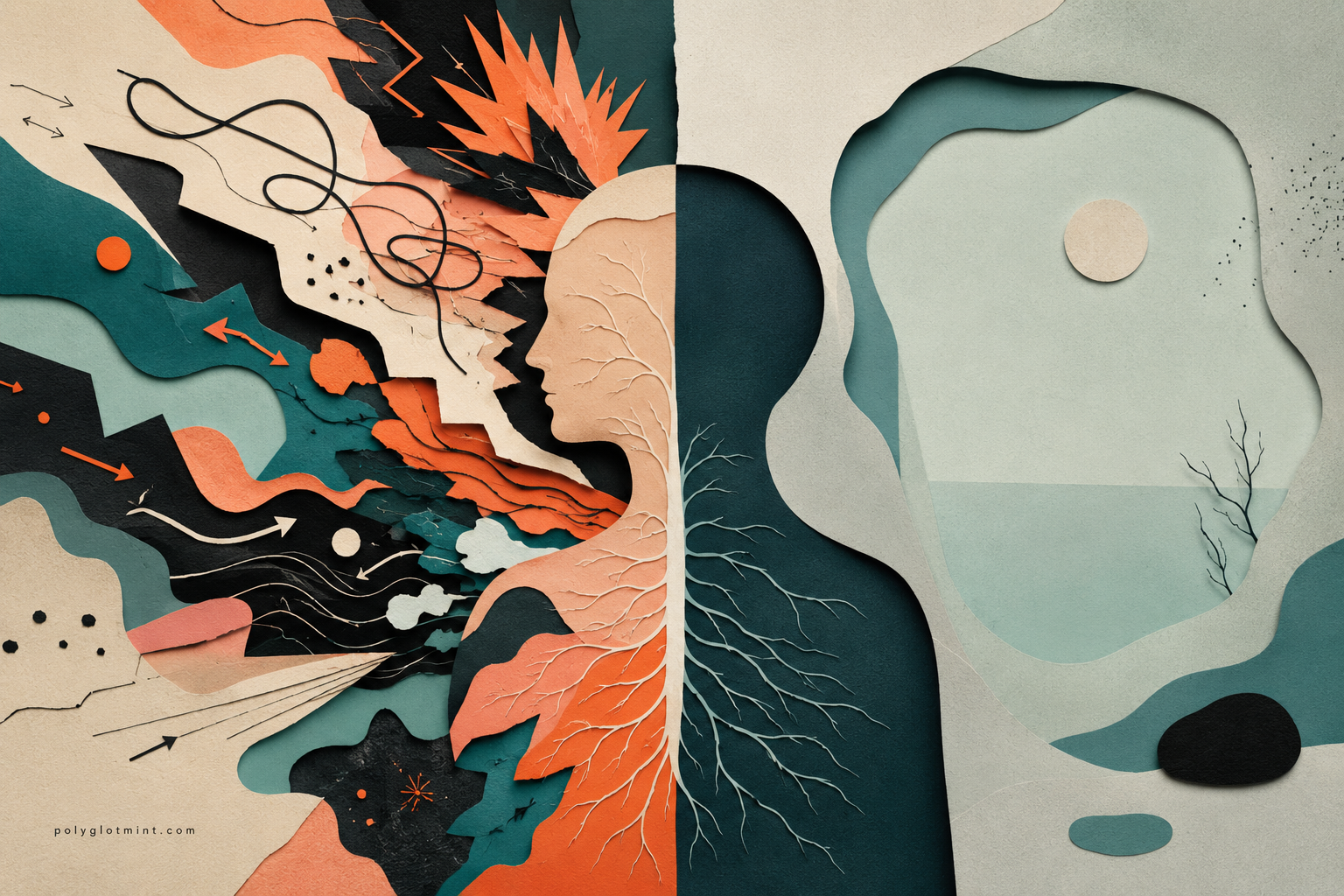
Image generated using AI under the creative direction and composition of Mint Achanaiyakul.
Abstract
Trauma response is often judged by visibility. Crying, shaking, panic, and visible distress are treated as signs of deep activation, while stillness, silence, numbness, or blankness are often misread as detachment, avoidance, or lack of insight.
This paper proposes a different model. Panic and blankness are not simply "more" or "less" trauma response. They are opposite protective strategies selected by the nervous system based on predicted survivability of emotional access.
Panic occurs when the body believes emotional expression can be survived. Blankness occurs when the body inhibits emotional access because feeling, remembering, or visualizing would exceed capacity. In this model, blankness is not emotional absence. It is protective containment.
The panic vs blankness trauma response framework reframes both reactions as survival intelligence, not personality, resistance, or motivation.
Clinical Boundary
1. The Panic vs Blankness Trauma Response Myth: "More vs Less"
The common mistake is to treat trauma expression as a volume dial.
A person crying appears to have "more trauma." A person going blank appears to have "less trauma."
But trauma does not always become visible through intensity. Sometimes the more extreme protection is not panic, but inhibition.
A panicking person may be overwhelmed, but still connected to emotion, memory, sensation, or narrative. A blank person may be so protected that the system does not permit conscious emotional access at all.
Panic and blankness are therefore not high emotion versus low emotion. They are different evaluations of danger.
Panic says: this is overwhelming, but access is possible. Blankness says: access is too dangerous right now.
This distinction matters because blankness is often punished, misread, or clinically underestimated. A survivor who cries may be seen as engaged. A survivor who becomes silent may be seen as avoidant. But the blank survivor may not be refusing access. Their nervous system may be blocking access to preserve function.
Blankness is not "nothing." It is the wall that appears when feeling is predicted to cost too much.
2. Panic: When Expression Feels Survivable
Panic response
High-arousal survival activation — the nervous system pushes distress outward through racing thought, urgency, and physical alarm.
Panic is dramatic because the nervous system permits discharge.
The body may shake, cry, sweat, shout, hyperventilate, or tremble. The heart races. Breathing changes. Muscles prepare for action. The system is flooded with survival energy.
But in panic, awareness is often still partly online.
The person may be terrified, but they can feel terror. They may be flooded, but they are still in contact with the flood. They may not be regulated, but the emotional signal is available.
According to Bessel van der Kolk (2014) in The Body Keeps the Score, trauma affects the body, brain, and patterns of response, often leaving defensive activation unfinished or repeatedly reactivated. Within the panic vs blankness trauma response model, panic can be understood as one form of this activation: the body attempting to express or discharge survival energy that has not yet been integrated.
Panic does not mean the trauma is mild. It means the system has allowed emotional access. The person may be in pain, but the pain is loud enough to be felt.
3. Blankness: When Access Is Inhibited
Blankness
A protective shutdown — the system lowers feeling and imagery to keep overwhelming material out of reach.
Blankness is different.
Blankness may appear as silence, numbness, stillness, fog, emotional vacuum, empty imagery, loss of words, flat expression, or the inability to "feel anything" when the person knows something should be there.
This is often misunderstood as apathy.
But blankness may be a protective veto.
When the nervous system predicts that accessing emotion would overwhelm the body, dismantle coherence, or trigger collapse, it may reduce signal rather than amplify it. Instead of releasing emotion, it inhibits emotion. Instead of producing imagery, it blocks imagery. Instead of allowing narrative, it cuts off access.
According to Ruth Lanius (2015) in Trauma-related Dissociation and Altered States of Consciousness, trauma-related dissociation involves altered states of consciousness across dimensions of time, thought, body, and emotion. Blankness belongs to this broader territory of altered access: not simply "not caring," but a shift in what consciousness can safely hold.
According to Allan Schore (2002) in Dysregulation of the Right Brain, traumatic attachment can involve patterns of hyperarousal and dissociation imprinted into the developing limbic and autonomic nervous systems. This supports the idea that trauma response is not only conscious emotion, but also regulatory organization.
In this model, blankness is not less intense than panic. It may be more protective. Panic preserves emotional access. Blankness restricts it.
Dissociation
A disconnection from feeling or awareness — a felt distance from one’s emotions, body, or surroundings under threat.
4. Why Blankness Is Misread
Psychic anesthesia
Protective emotional numbing — the muting of feeling that shields the system from pain it cannot yet safely process.
Blankness is often misread because it does not perform distress in a recognizable way.
In clinical settings, a blank client may be described as resistant, detached, guarded, avoidant, dissociated, unmotivated, or lacking insight. In families or relationships, the same person may be called cold, emotionless, passive, lazy, or "not trying."
These labels mistake presentation for capacity.
A person in blankness may want to feel, speak, remember, imagine, or explain, but the nervous system has closed the gate. The absence of visible emotion does not prove the absence of emotion. It may prove that emotion is being contained below the threshold of conscious access.
This is especially important in trauma work because emotional visibility can become a false measure of progress.
A person who cries is not automatically healing faster. A person who goes blank is not automatically refusing to heal. They may be on different branches of the same survival tree.
5. Panic vs Blankness as Opposite Protective Strategies
The panic vs blankness trauma response model can be summarized simply:
Panic: the nervous system predicts that emotional access is survivable. Blankness: the nervous system predicts that emotional access exceeds capacity.
This does not mean panic is easy or safe. Panic can be terrifying and destabilizing. It also does not mean blankness always indicates the most severe trauma. People can move between panic, blankness, anger, collapse, dissociation, or numbness depending on context, history, relationship, body state, and trigger type.
The claim is narrower: when blankness reliably appears at the point of emotional access, it may function as protective inhibition rather than lack of feeling.
This also helps explain why some survivors experience blank inner imagery during visualization. They may not "lack imagination." Their system may block inner images because images would bring the person too close to emotional material before the body has enough safety to hold it.
In Psychomedia language, blankness is close to psychic anesthesia: the system numbs awareness to preserve coherence.
6. Implications for Healing
When blankness is understood as protection, the therapeutic stance changes.
The goal is no longer to force emotion out of the person. The goal is to build enough safety that emotional access no longer feels life-threatening to the body.
This changes the sequence of healing.
Safety comes before exposure. Regulation comes before narrative. Embodiment comes before interpretation. Capacity comes before emotional intensity.
According to Stephen Porges (2011) in The Polyvagal Theory, autonomic state is central to how the body evaluates safety, mobilization, and shutdown. While Polyvagal Theory should be used carefully as a theoretical model, its emphasis on defensive state shifts is useful for understanding why some trauma responses move toward activation while others move toward immobilization.
For blankness, progress may not begin with tears. It may begin with a flicker of sensation, a partial image, a single word, a breath, a body cue, or the ability to stay present for one more second before the gate closes.
That is not failure. That is access returning.
7. Notes on Novelty
Trauma literature has already described sympathetic arousal, dissociation, shutdown, and altered states of consciousness. This paper adds a specific Psychomedia reframing: panic and blankness should not be treated as two ends of a simple emotional-intensity spectrum.
They are better understood as opposite protective strategies. Panic is protection through expression. Blankness is protection through inhibition.
The model also offers a clinical prediction: as safety and regulation capacity increase, survivors who default to blankness may show gradual return of access before full emotional expression or narrative recall becomes possible. This return may appear first as faint imagery, subtle bodily sensation, partial memory, emotional texture, or the ability to name what was previously unreachable.
In other words: more feeling is not always proof of more trauma. Sometimes more feeling is proof of more capacity.
Conclusion
Panic and blankness are both survival responses.
Panic is not weakness. Blankness is not indifference. Panic means the trauma has become loud enough to enter awareness. Blankness means the nervous system has decided that awareness must be limited for protection.
The mistake is ranking them as more or less emotional.
The deeper truth is that both are intelligent attempts to survive contact with what has not yet been integrated.
A survivor who panics needs regulation, containment, and respect. A survivor who goes blank needs the same. Not pressure. Not judgment. Not forced insight.
The body opens when it believes opening is survivable.
Until then, blankness is not the absence of feeling. It is the protection of feeling that cannot yet be safely held.
Achanaiyakul, M. (2025). Panic vs Blankness Trauma Response: The Two Opposite Trauma Responses We Misinterpret. PolyglotMint.com.
References
Lanius, R. A. (2015). Trauma-related Dissociation and Altered States of Consciousness: A Call for Clinical, Treatment, and Neuroscience Research. European Journal of Psychotraumatology.
Porges, S. W. (2011). The Polyvagal Theory: Neurophysiological Foundations of Emotions, Attachment, Communication, and Self-regulation. W. W. Norton.
Schore, A. N. (2002). Dysregulation of the Right Brain: A Fundamental Mechanism of Traumatic Attachment and the Psychopathogenesis of Posttraumatic Stress Disorder. Australian & New Zealand Journal of Psychiatry.
Van der Kolk, B. A. (2014). The Body Keeps the Score: Brain, Mind, and Body in the Healing of Trauma. Viking.