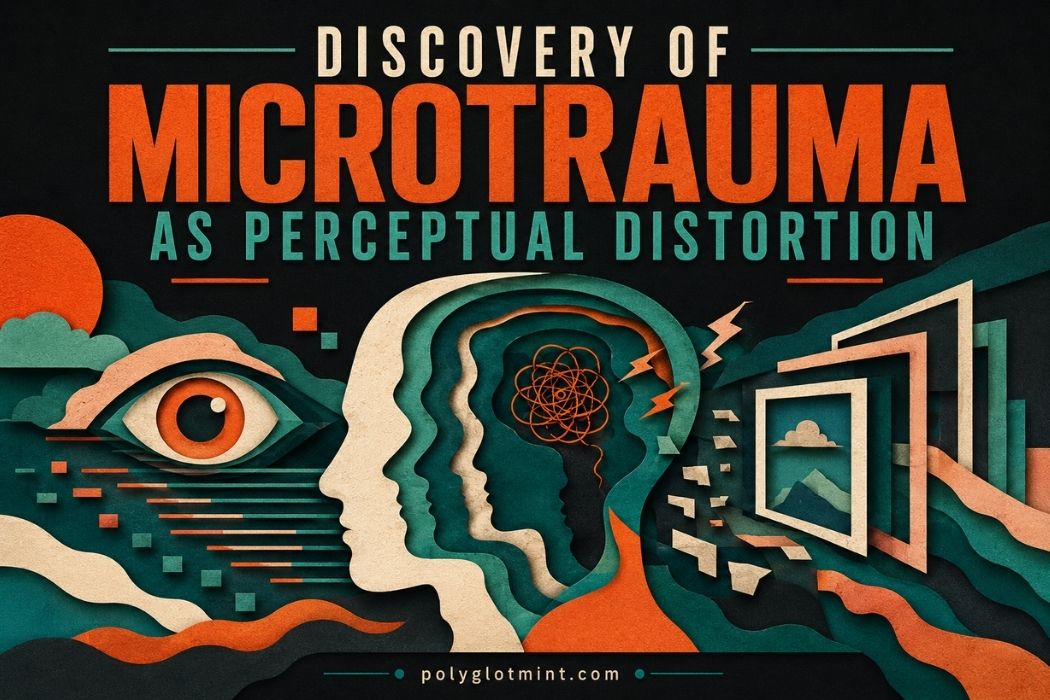
Image generated using AI under the creative direction and composition of Mint Achanaiyakul.
How the Discovery of Microtrauma began
The discovery of microtrauma did not begin with catastrophe. It began with a quieter question: why were certain images, scenes, and symbolic arrangements affecting the nervous system in ways that felt too small to be called trauma, yet too persistent to be harmless?
The disturbance did not always register as emotional first. It often registered as perceptual. Something felt wrong before it could be explained. Distorted images, upside-down imagery, warped spatial cues, duplicated people, contradictory symbolic signals, and other forms of perceptual wrongness seemed to produce a low-grade disturbance that did not disappear when the image ended. The more I noticed this pattern, the more it became clear that the harm was not only in what media said, but in how it trained the nervous system to tolerate what should have felt dissonant.
That was the beginning of the discovery of microtrauma.
The damage that did not look big enough
Trauma theory has usually focused on rupture. According to Herman (1992) in Trauma and Recovery and van der Kolk (2014) in The Body Keeps the Score, trauma overwhelms integration, memory, and bodily regulation. Microtrauma first appeared to me in a different form: not as rupture, but as gradual abrasion.
The injury was not unbearable in one moment. It was repeatedly absorbable. That is what made it hard to name and easy to normalize.
The first clue: the injury was perceptual
The first real clue was that the disturbance was perceptual before it was conceptual. Some images did not merely communicate an idea; they produced a low-grade error signal in the body.
A duplicated face did not just look stylistic. It felt neurologically wrong. A spatial impossibility did not just look surreal. It created unease. An upside-down image did not just seem creative. It interfered with orientation. The system was receiving contradiction before language had fully caught up.
This is where predictive-coding logic became useful. According to Friston (2010) in The Free-Energy Principle: A Unified Brain Theory?, the brain continuously works to reduce mismatch between expectation and incoming input. Perceptual distortion matters because it introduces low-grade contradiction into that process. The image does not fully resolve into stable meaning, so the nervous system remains engaged in subtle error correction. What first looked merely aesthetic began to look like repeated perceptual strain.
Why it was hard to name
Microtrauma stayed hidden for the same reason it was effective: each instance seemed too small to count.
One distorted image could be dismissed. One inverted scene could be explained away. One symbolic contradiction could be treated as artistic license. Culture made the injuries easy to normalize because they were aestheticized, repeated, and familiar. The nervous system adapted before the mind named the pattern.
That is what made the discovery important. The harm was cumulative, not singular.
Discovery of Microtrauma through repetition
What made the pattern traumatic was repetition.
Repeated exposure to perceptual wrongness does not simply create momentary confusion. It retrains expectation. The nervous system begins to tolerate contradiction that would once have felt disruptive. Dissonance dulls. The threshold for what feels wrong moves.
According to Sapolsky (2004) in Why Zebras Don't Get Ulcers, chronic stress differs from acute threat because its effects accumulate gradually and reorganize baseline regulation over time. That logic helped clarify microtrauma. The injury was not only the image itself. It was the repeated adaptation to unresolved contradiction.
Perceptual distortion as the mechanism
The discovery sharpened when I realized that microtrauma was not just "small trauma" in a general sense. It had a mechanism. Perceptual distortion was one of the clearest ways to see it.
Perceptual distortion does not only mean visual ugliness or surreal style. It includes anything that quietly interferes with perceptual trust: distorted bodies, inverted images, impossible spatial relationships, duplicated figures, symbolic contradiction, emotional signals that do not match the form carrying them. When repeated often enough, these distortions teach the nervous system to normalize unresolved wrongness.
That was the breakthrough. Microtrauma was not only emotional injury delivered through content. It could also be perceptual injury delivered through form.
Table 1. Discovery logic of microtrauma
| Element | Function |
|---|---|
| Perceptual distortion | Creates low-grade error signals in perception |
| Repetition | Makes the injury cumulative rather than isolated |
| Adaptation | Dulls dissonance and normalizes contradiction |
| Microtrauma | Slow erosion of coherence and perceptual trust |
This table is intentionally compact. Its purpose is not to turn the discovery into a formula, but to show the sequence by which the pattern became visible.
When distortion becomes atmosphere
The deeper danger of microtrauma is that it does not remain confined to single moments. It becomes atmosphere.
Once contradiction is repeated enough, it stops feeling exceptional. Distortion begins to feel ordinary. Wrongness begins to feel livable. This is how microtrauma turns from perceptual event into psychic environment.
At that point, the damage is no longer only aesthetic or emotional. It becomes moral and perceptual. Good can begin to feel weak, false, or naive, while deception, instability, and distortion begin to feel normal, sophisticated, or powerful. What is harmful starts to feel familiar, and what is healthy starts to feel strange.
According to Porges (2011) in The Polyvagal Theory, persistent threat constrains autonomic regulation and narrows the system's range of flexible engagement. In the logic of microtrauma, that means the system can be trained not only by overt danger, but by repeated low-grade contradiction until tolerating distortion becomes a baseline mode of adaptation.
Discovery of Microtrauma and dissonance
This is why the discovery of microtrauma belongs inside Psychomedia and alongside the broader dissonance framework. Microtrauma became legible when I realized that dissonance was not just being triggered. It was being trained into normalcy.
Perceptual contradiction that should have functioned as warning was being absorbed as style, mood, rhythm, and atmosphere. The system was no longer using dissonance to reject distortion. It was learning to stabilize inside it.
That is what made the discovery significant. It revealed how symbolic and perceptual contradiction can become a conditioning mechanism, not only a moment of discomfort.
Why this discovery mattered
This discovery changed the frame.
It explained why certain media environments felt erosive even when they were not overtly catastrophic. It explained why some forms of symbolic violence were easy to miss yet hard to shake. It explained how consciousness could be worn down through repetition without anyone needing to name the process trauma in real time.
Microtrauma is what happens when distortion becomes normal enough to survive and repetitive enough to reorganize.
That insight helped crystallize The Micro-Trauma Effect as a concept. The psyche is not always broken all at once. Sometimes it is trained, slowly, to live inside what should never have become tolerable.
Notes on Novelty
Trauma theory has largely emphasized rupture, overwhelm, and the bodily consequences of catastrophic stress. The discovery of microtrauma contributes a different entry point: perceptual distortion as cumulative injury.
Its central contribution is identifying a sequence by which subtle symbolic wrongness becomes traumatic through repetition. Perceptual contradiction produces low-grade error signals; repetition makes those signals cumulative; adaptation dulls dissonance; and coherence slowly erodes.
This discovery clarifies the conceptual foundation of microtrauma by showing that some forms of trauma are not first recognized as emotional catastrophe, but as repeated perceptual distortion that the nervous system learns to endure.
Achanaiyakul, M. (2026). Discovery of Microtrauma as Perceptual Distortion. PolyglotMint.com.
References
Friston (2010). The Free-Energy Principle: A Unified Brain Theory?. (Nature Reviews Neuroscience)
Herman (1992). Trauma and Recovery. (Basic Books)
Porges (2011). The Polyvagal Theory. (Norton)
Sapolsky (2004). Why Zebras Don't Get Ulcers. (Holt Paperbacks)
van der Kolk (2014). The Body Keeps the Score. (Viking)