The Neuro-Moral Spectrum (NMS)
Mapping Virtue and Vice in the Human Brain
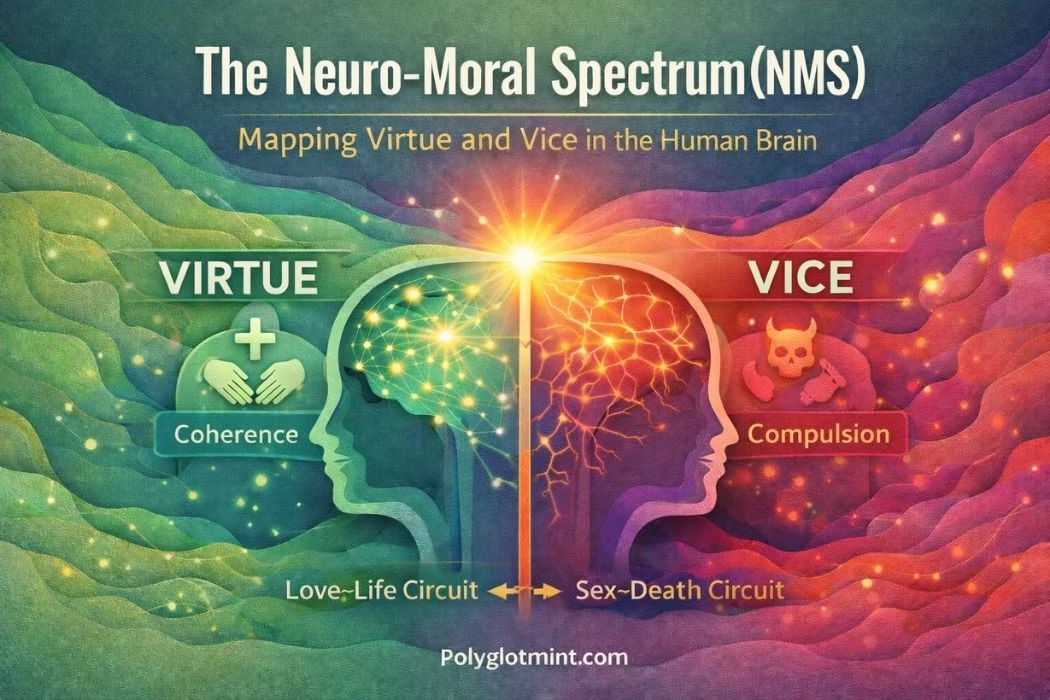
Image generated using AI under the creative direction and composition of Mint Achanaiyakul.
The Neuro-Moral Spectrum (NMS) was developed by Mint Achanaiyakul as part of the Psychomedia framework.
Abstract
The Neuro-Moral Spectrum (NMS) extends the Duality of Neural Programming (DNP) into the moral domain. It proposes that what theology calls virtue and sin can be interpreted as two hypothesized recurrent state orientations: the Love–Life Circuit (Coherence) and the Sex–Death Circuit (Chaos). Each orientation expresses a characteristic pattern of state regulation, reward drive, and social bonding that can be studied through converging markers (autonomic tone, attentional rhythm, reward sensitization, and threat reactivity).
NMS reframes morality not as mere social conditioning, but as neural resonance: a spectrum between coherence and compulsion, where the brain behaves like a moral instrument—tuning perception, impulse, and meaning toward creation or corruption.
Neuro-Moral Spectrum: Definition and Framework
The Neuro-Moral Spectrum (NMS) defines moral polarity as a shift in nervous-system state—toward coherence or toward compulsion.
Love–Life (Coherence) is associated with stable regulation, social safety, and integrative attention. Sex–Death (Chaos) is associated with reward overdrive, threat vigilance, and fragmentation of authorship. In this framing, “good and evil” are not treated as metaphors only, but as lived neurophysiological directions that become visible through behavior and measurable through state markers.
Psychomedia is the psychology of media, trauma, and control. In this context, NMS becomes one way to describe how repeated inputs can entrain the moral nervous system over time—rewarding coherence or training compulsion.
Core Circuits of Moral Polarity
Table 1. The Love–Life Circuit (Coherence)
| Fruit of the Spirit | Micro-traits / behavioral correlates | Neural basis (high-level hypothesis) |
|---|---|---|
| Love | Compassion, altruism, forgiveness | Prosocial bonding + integrative regulation |
| Joy | Gratitude, playfulness, creativity | Stable mood tone + flexible attention |
| Peace | Calm, acceptance, safety perception | Parasympathetic dominance + reduced threat bias |
| Patience | Restraint, endurance, hope | Prefrontal governance of impulse |
| Kindness | Empathy, generosity, tenderness | Social attunement + warm approach behavior |
| Goodness | Integrity, honesty, moral coherence | Low self-deception + consistent action selection |
| Faithfulness | Reliability, loyalty, devotion | Bond stability + reduced novelty addiction |
| Gentleness | Humility, calm strength | Low reactivity + controlled assertiveness |
| Self-control | Discipline, temperance, mastery | Executive inhibition of compulsive loops |
Biblical vocabulary: Galatians 5:22–23 (KJV).
This table describes coherence as a state where regulation serves relationship, truth, and creation—where arousal exists, but is governed.
Table 2. The Sex–Death Circuit (Chaos)
| Sin / distortion | Micro-traits / behavioral correlates | Neural basis (high-level hypothesis) |
|---|---|---|
| Lust | Addiction, objectification | Reward capture overriding conscience |
| Gluttony | Excess, escalation, binge cycles | Reward dysregulation + tolerance |
| Greed | Hoarding, possessiveness | Scarcity loops + status fixation |
| Sloth | Apathy, anhedonia, withdrawal | Reward blunting + avoidance |
| Wrath | Aggression, vengeance | Threat dominance + weak inhibition |
| Envy | Comparison, resentment, social pain | Status threat + hostility toward others’ gain |
| Pride | Grandiosity, narcissism | Self-image reward bias + empathy collapse |
“Seven deadly sins” is a later Christian moral taxonomy (not a single biblical list).
This table frames “sin” as a distortion state: the nervous system becomes organized around compulsion, control, and escalation.
Figure 1. The Neuro-Moral Spectrum — Virtue ↔ Vice (2025)

Micro-Traits as a Spectrum
NMS treats virtue and vice as clusters rather than isolated acts. One act of restraint does not equal coherence; one act of anger does not equal chaos. The spectrum is defined by what becomes easy, what becomes rewarding, and what becomes automatic.
A key NMS claim is that long-term conditioning shifts the baseline: coherence can begin to feel “boring,” while compulsion begins to feel “alive.” That inversion is one of the clearest signatures of a nervous system that has been trained away from Love–Life and toward Sex–Death.
Empirical Anchors
NMS is a framework-level synthesis, so its credibility depends on whether its two “directions” map onto real, repeatable findings. Several well-established lines of work support the basic polarity even if a full NMS measurement battery remains a research goal. These lines of evidence support state-dependence in trust, reward, threat, and affect; they do not by themselves validate the full NMS mapping.
According to Kosfeld et al. (2005) in Oxytocin increases trust in humans, experimentally shifting social neurochemistry can increase trusting behavior—supporting the idea that moral-social orientation is state-sensitive, not purely ideological.
According to Klimesch (2012) in Alpha-band oscillations, attention, and controlled access to stored information, alpha activity is deeply tied to attentional control and access to stored representations—an anchor for describing “coherence” as regulated access rather than mere calmness.
According to Robinson & Berridge (2008) in The incentive sensitization theory of addiction: Some current issues, reward systems can become sensitized so that “wanting” escalates independent of genuine “liking”—a clean mechanistic bridge to compulsion states in the Sex–Death direction.
According to Takahashi et al. (2009) in When your gain is my pain and your pain is my gain, envy and schadenfreude show identifiable neural correlates—supporting NMS’s claim that “vice states” are not only moral categories but measurable affective configurations.
According to Davidson (2000) in Affective style, psychopathology, and resilience: Brain mechanisms and plasticity, stable individual differences in affective style relate to resilience and regulation—an anchor for treating virtue-like stability as a nervous-system trait shaped by plasticity.
According to Porges (2017) in The Pocket Guide to the Polyvagal Theory, perceived safety and autonomic state strongly constrain social engagement and regulation—supporting the NMS emphasis that coherence is inseparable from safety physiology.
Interpretation and Integration
NMS transforms DNP from “oscillation” into “meaning.” Coherence is not merely low arousal; it is regulated arousal in service of truth and relationship. Chaos is not merely high arousal; it is arousal that captures authorship—turning impulse into identity and reward into law.
Courage becomes the hinge state—the tipping point where rising arousal can either stay governed or become hijacked: the capacity to hold intensity without surrendering coherence. In NMS terms, courage is not fearlessness; it is coherence under pressure. It can be expressed in two directions: Love–Life courage governs arousal in service of truth, protection, and responsibility, while Sex–Death “courage” is a counterfeit—bravery-shaped escalation into recklessness, domination, or compulsive self-sacrifice.
Notes on Novelty
NMS introduces a moral–neural continuum that treats virtue and vice as state clusters with measurable anchors (reward sensitization, affective style plasticity, attentional control rhythms, and social-safety physiology). It extends DNP into ethics without reducing morality to chemistry: the claim is not “chemicals are morality,” but “moral direction shows up as repeatable nervous-system organization.”
Mint Achanaiyakul, 2025. The Neuro-Moral Spectrum (NMS): Mapping Virtue and Vice in the Human Brain. (Psychomedia)
References
Davidson (2000). Affective style, psychopathology, and resilience: brain mechanisms and plasticity. (American Psychologist)
Klimesch, 2012. Alpha-band oscillations, attention, and controlled access to stored information. (Trends in Cognitive Sciences)
Kosfeld et al, 2005. Oxytocin increases trust in humans. (Nature)
Porges, 2017. The Pocket Guide to the Polyvagal Theory. (W. W. Norton & Co)
Robinson & Berridge (2008). The incentive sensitization theory of addiction: some current issues. (Philosophical Transactions of the Royal Society B: Biological Sciences)
Takahashi et al, 2009. When your gain is my pain and your pain is my gain. (Science)